
von Christian Achilles, Aurelia Schütz, Sarah Kühl
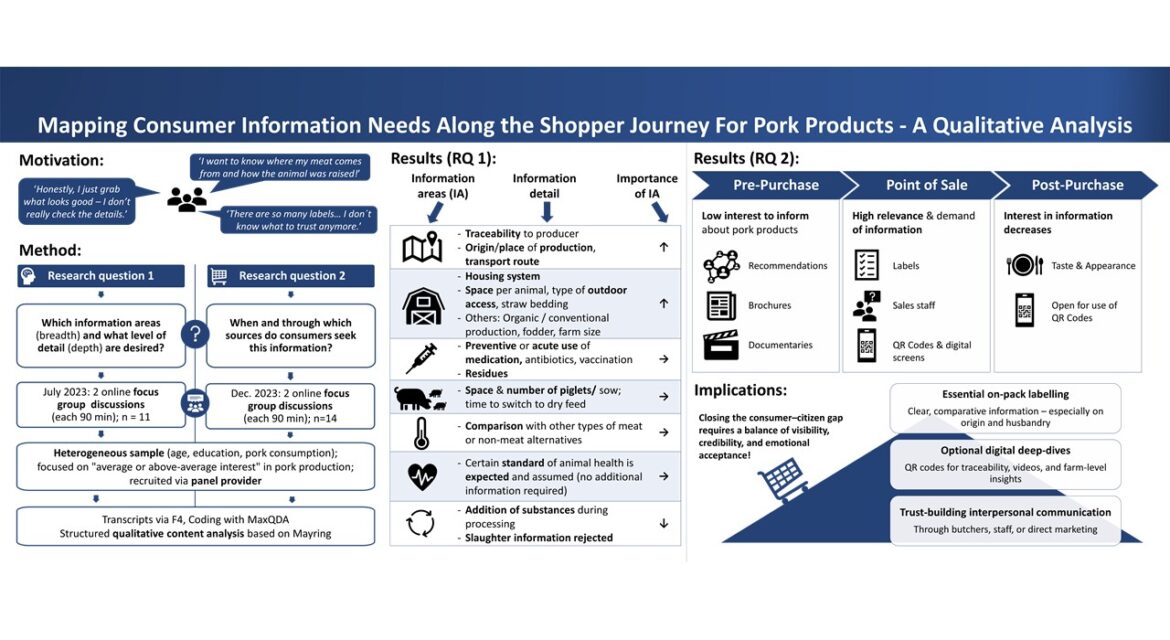
Kürzlich wurde im Journal of Agriculture and Food Research ein wissenschaftlicher Beitrag veröffentlicht, der untersucht, welche Informationsinhalte und welche Detailtiefe Konsumentinnen und Konsumenten beim Kauf von Schweinefleisch bevorzugen. Darüber hinaus analysiert die Studie, wann und über welche Informationsquellen Konsumentinnen und Konsumenten entlang der Shopper Journey auf Informationen zurückgreifen und wie sie die jeweiligen Vor- und Nachteile dieser Informationsquellen wahrnehmen. Das Paper entstand im Rahmen des Arbeitspakets „Evaluation Verbraucherverhalten“ und wurde von Christian Achilles und Dr. Aurelia Schütz von der Georg-August-Universität Göttingen sowie Prof. Dr. Sarah Kühl von der Hochschule Weihenstephan-Triesdorf verfasst. Im Anschluss folgt der Original-Abstract in englischer Sprache sowie der Link zum vollständigen Manuskript.
Mapping consumer information needs for pork products along the shopper journey using focus group discussions
Despite growing public concern for animal welfare and transparency in meat production, the market share of pork from higher-welfare systems remains low. This study investigates how German pork consumers perceive and process information on pork production, exploring information-related factors that may contribute to the limited market acceptance of higher-welfare pork. Four online focus groups (n = 25) were conducted with consumers recruited via a national panel ensuring diversity in age, gender, income, and purchasing behaviour. Two groups (n = 11) explored which information attributes consumers consider relevant and how much detail they prefer, while two additional groups (n = 14) examined when and through which sources they seek information along the shopper journey. Using qualitative content analysis, this study identifies heterogeneous information preferences, with animal husbandry and origin as the only attributes consistently associated linked to detailed information demand. Topics like slaughter, medication use, or environmental impacts were less requested or selectively avoided, often due to cognitive dissonance, information overload, or low perceived relevance. Most information seeking occurred at the point of sale, where on-pack labels dominated due to visibility and immediacy. However, participants criticised label ambiguity and desired relational framing with benchmarks or ratings. Digital extensions like Quick Response codes and in-store displays were discussed as promising but underused tools, facing barriers such as low trust, usability issues, and emotional resistance. As an exploratory qualitative study, the findings provide first in-depth insights into consumer information behaviour along the shopper journey and highlights practical levers to reduce the consumer citizen gap through improved communication.
Journal of Agriculture and Food Research
Volume 25, February 2026, 102567
Doi 10.1016/j.afr.2025.102567